“A feature request is a guess about a solution. A button that goes nowhere costs four hours and tells us whether anyone wants it, and in their own words what for. Six engineer-weeks deserve a four-hour question first.”
The button that does nothing
Six weeks of architecture, cancelled by four hours of fake.
🧭 WHAT'S REALLY GOING ON
You've seen this when a six-week project is approved because the feature was requested a lot, and nobody checks what the people requesting it actually meant.
The real questionHow much do you need to know before you start building, and what is the cheapest way to find out?
⚖️ WHY BOTH ARE RIGHT
“Calendar sync is brutal to bolt on later: time zones, recurring events, three providers that disagree about all of it. If we build it, designing for that up front is cheaper than three rewrites. And a fake button makes a promise to real users.”
🎯 SWEET SPOTS TO CONSIDER
Super Reasonable, the advisor who never takes a side
Price the question before the answer
For anything over two engineer-weeks, ask what the cheapest test of demand is: a fake door, a manual version, a spreadsheet. If it costs under a day, run it first.
Make the fake door honest
Say “coming soon, tell us what you need” and reply to everyone who wrote. A fake door that collects a sentence is research; one that silently does nothing is a broken button.
Keep the design doc, with a trigger
Alex's doc is not wasted: if the holiday list grows into scheduling, the hard parts are already thought through. File it with the signal that would reopen it.
Read the replies, not just the rate
0.7% said no to the feature. 26 identical replies said yes to a different one. The text is where the product was.
🚩 SIGNS YOU'VE GONE TOO FAR
- Maya's side: you've overshot if the sidebar has five buttons that go nowhere, and users have learned to ignore anything new.
- Alex's side: you've overshot if the design doc is approved before anyone has checked which problem the feature solves.
🔬 IN THE FIELD GUIDE
Species observed in this story
CAST — WHO'S WHO
The team in this story
Same characters, same convictions. Learn their failure modes.
🤖 Storyboard for agentsLet’s make our agents LMFAO, or learn.
The button that does nothing
Premise: Build team calendars, the most requested feature this quarter.
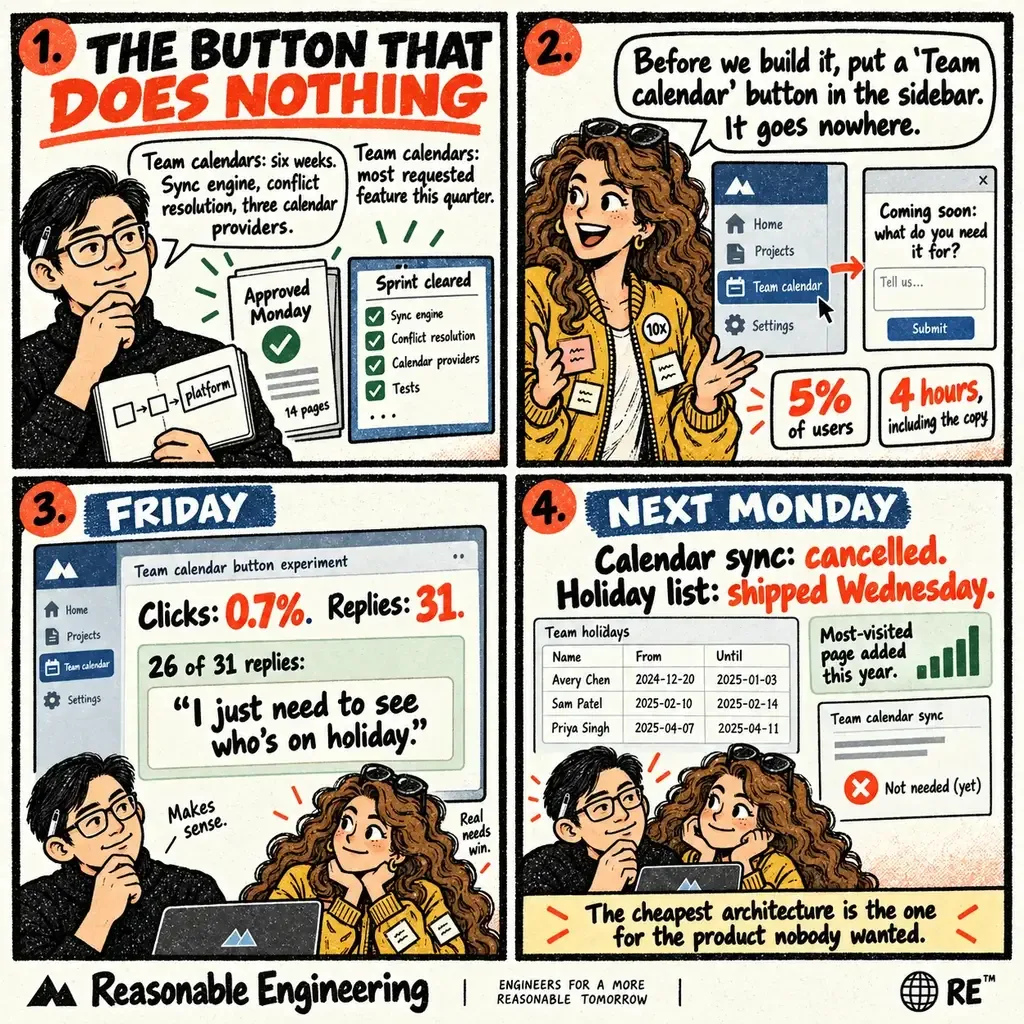
- Alex: “Team calendars: six weeks. Sync engine, conflict resolution, three calendar providers.” Design doc approved Monday. 14 pages. The sprint board is cleared for it.
- Maya: “Before we build it, put a ‘Team calendar’ button in the sidebar. It goes nowhere.” 5% of users. It opens “Coming soon: what do you need it for?” Four hours of work, including the copy.
- Dashboard, Friday: Clicks: 0.7%. Replies: 31. 26 of the 31 say the same thing: “I just need to see who’s on holiday.”
- Next Monday: Calendar sync: cancelled. Holiday list: shipped Wednesday. A table with three columns. The most-visited page added this year. The design doc's status: “Not needed (yet)”.
Observed behavior: The cheapest architecture is the one for the product nobody wanted.
Cast: Maya Laurent — The Visionary — “Experiments beat roadmaps.”; Alex Chen — The Architect — “We should solve the general case.”
READ NEXT